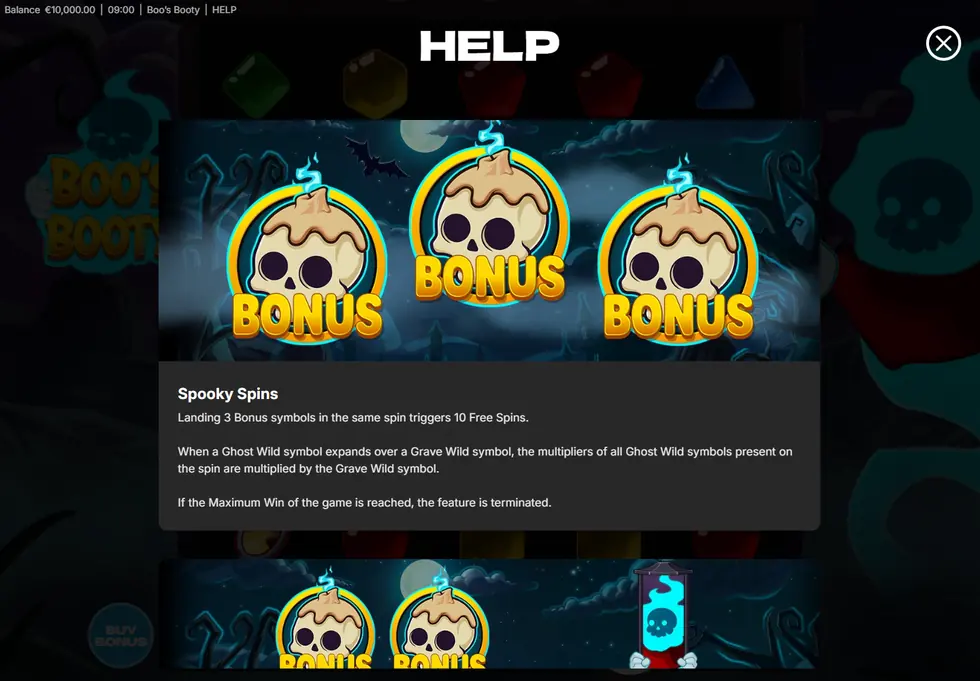
The trigger is 3 cream skull candles marked Bonus, landing in the same spin. The feature then runs 10 free spins on the same 5 reels by 5 rows and the same fifteen fixed lines as the base game.
Its own description puts the Wild overlap at the centre: when a ghost expands over a tombstone, the tombstone value changes the ghost multipliers in play for that spin. Nothing else about the mode is new, which is a compliment — there is no second rule set to learn before the first free spin lands.
Phantom Spins: four Bonus symbols, and ghosts that stay
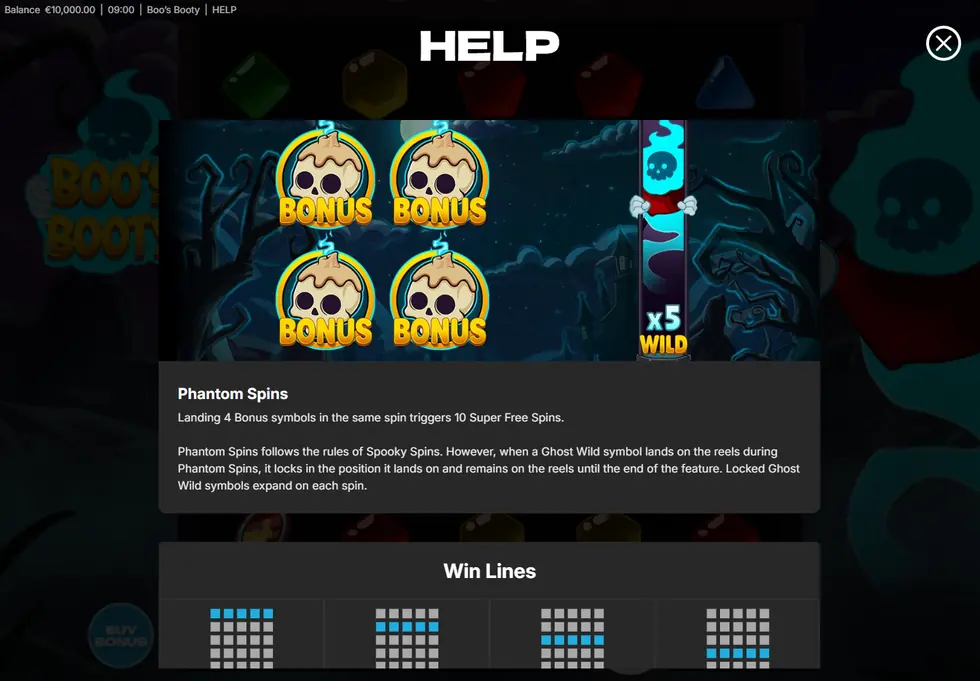
4 Bonus symbols in one spin start Phantom Spins, which the game also calls Super Free Spins, and which also awards 10. One extra trigger symbol buys one extra rule, and that is the trade the mode is built on.
The trigger artwork tells you which rule: four candles beside a ghost already standing at full height. Every ghost that lands during the feature locks in position, remains to the end, and expands again on each later spin.
Four candles and one ghost already standing: the picture the game uses for Phantom Spins.
What persistence actually changes on the reels
A locked ghost keeps its landing row, which means it keeps its height, which means it keeps its multiplier. That repeats for every remaining spin while the paying symbols and any new tombstones are redrawn around it.
More ghosts can lock on the other reels, still one to a reel, so coverage can only grow during the feature. This is the only mechanism in the game that compounds across spins: in the base game and in Spooky Spins, every spin starts from an empty grid.
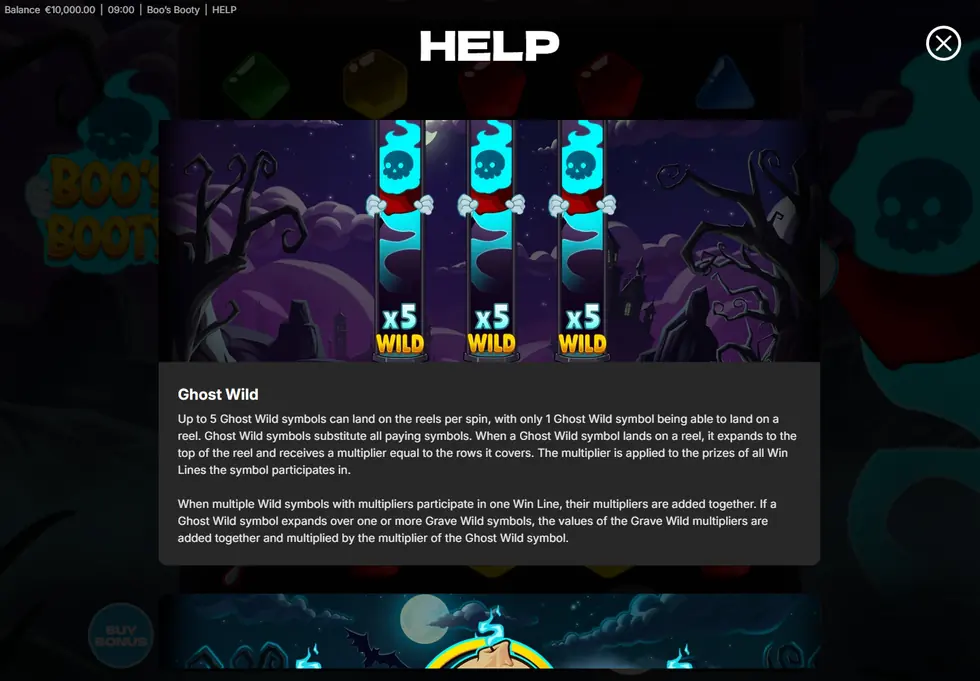
Three full-height expansions. Each covers five rows, and each shows x5 at the foot of the stretched symbol.
The overlap rule inside a feature
Both modes keep the rule that matters. Independent Wild multipliers on a line are added; a ghost expanding over tombstones adds those printed values together and multiplies the total by its own. Locking simply means a ghost is already in place when the next batch of tombstones arrives.
That is why a low ghost locked on the first Phantom spin is worth so much more than the same ghost on the last. Nine further spins of tombstones will land underneath it, and each of them is a chance for a sum to become a product.
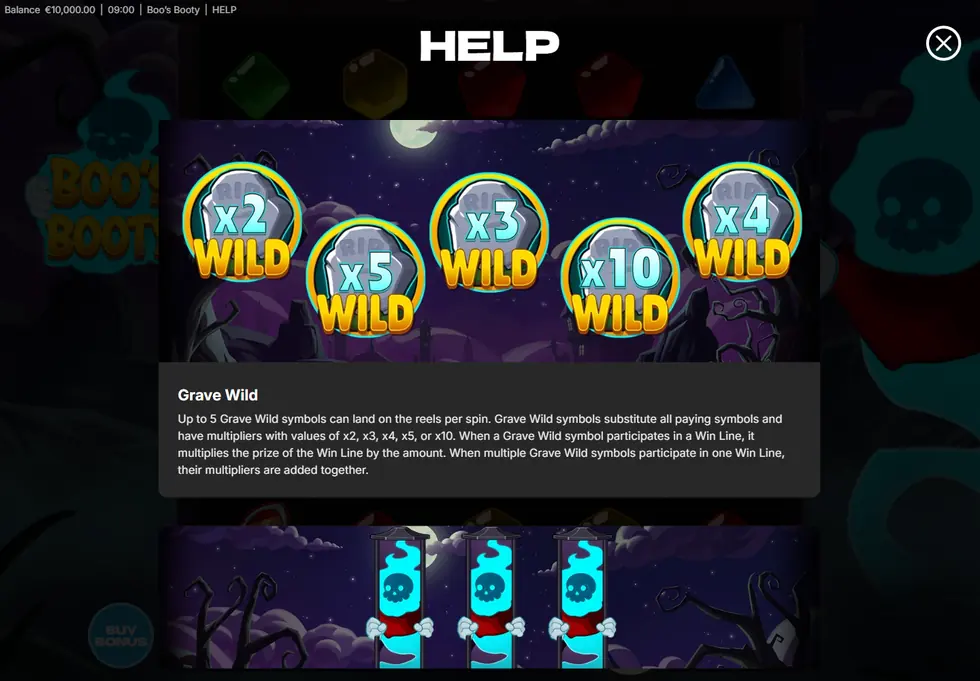
All five tombstones use one silhouette and change only the number in the middle.
Buying in: what each entry costs, and what it does not buy
The feature panel sells both modes. Spooky Spins costs 100x the bet and Phantom Spins 300x; at a displayed 1.00 stake those read 100.00 and 300.00. A third option, Double Chance, costs 1.5x and doubles the chance of a trigger arriving naturally instead of handing one over.
A paid entry gives you the trigger. It does not give you more than 10 spins, does not alter a Wild value, does not raise the 20,000x ceiling and does not make a lock more likely. Three hundred times a stake is a large bet placed in one action, and it is placed on exactly the same ten spins you would otherwise have waited for.
The return figures attached to each route in
Our source lists a separate figure for each way into the game: 95.79% playing normally, 95.80% entering Spooky Spins through the feature option, 95.86% entering Phantom Spins the same way, and 95.80% with Double Chance active. The spread across the four is small, and the direction of it is the interesting part — paying for the feature does not buy a worse game, it buys a different distribution of the same one.
A second band of four figures circulates about three points lower, starting from 92.74%, arranged in the same four steps. The two bands are consistent with each other in every other respect, which points at two builds of one game rather than at an error. Check the information panel in the client you are signed in to: it describes the build you are actually playing, and this page cannot.
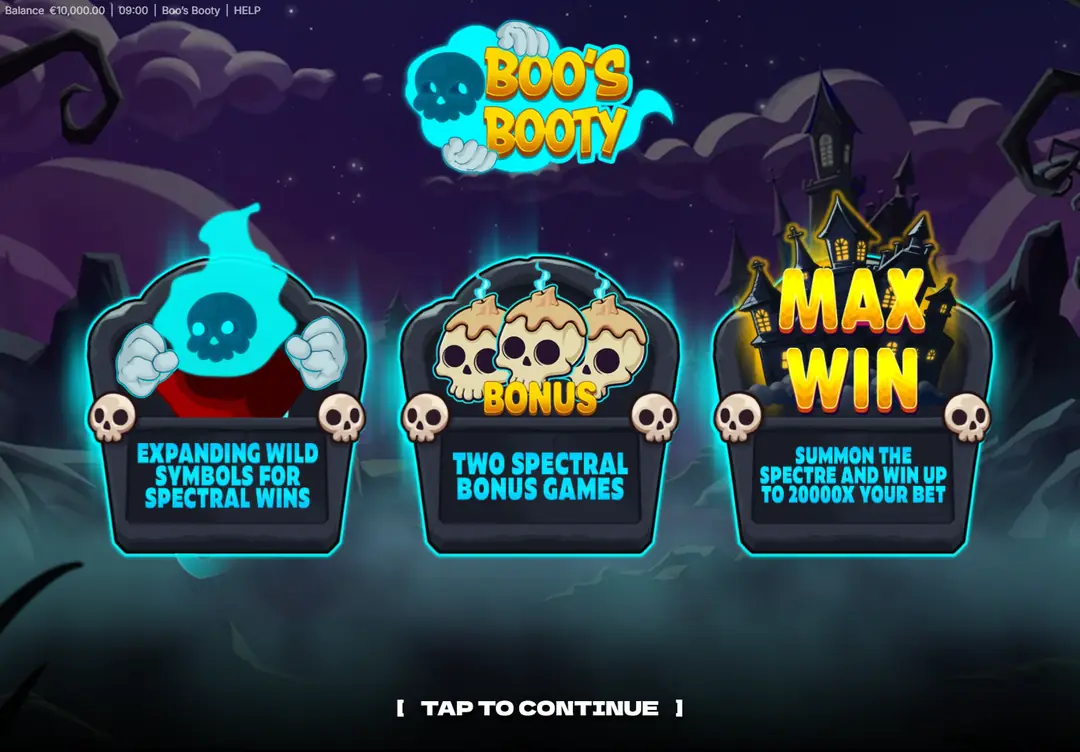
The screen the game opens on: the expanding Wild, the two bonus games and the headline maximum, each in its own panel.
Where a free mode can be opened
The game ships a free mode and other people's pages carry it: catalogue pages that run the title without an account, a British free-play index that lists it, and operator lobbies that offer free play and real money through the same control. If you want to see ten Phantom Spins resolve before staking anything, that is where it is done.
It is not done here. This site has no playable copy, no demo button, and no link dressed up as one. Naming where the free mode exists is a statement about the game; promising it on this page would be a statement about us, and it would be false.
Questions about the two bonus modes
How many Spooky Spins are awarded?
Ten, from 3 Bonus symbols landing in the same spin.
How many Phantom Spins are awarded?
Ten, from 4 Bonus symbols landing in the same spin.
Do both modes use the same grid and lines?
Yes. Both keep the five-by-five cabinet and the fifteen fixed lines of the base game.
What do the paid entries cost?
100x the bet for Spooky Spins and 300x for Phantom Spins. Double Chance costs 1.5x and doubles the chance of a natural trigger rather than handing one over.
None of the three adds spins, changes a Wild value or raises the ceiling. What is bought is the trigger, at a price printed beside the button.
What return to player is listed?
Our source lists 95.79% for the base game and three more figures for the three paid routes into it, one per route.
A second set of four is published elsewhere about three points lower, 92.74% at its base, in the same four-step shape and beside figures that match ours exactly. Two consistent ladders are two operator builds, so the information panel inside the client you are signed in to is the only one that describes yours.
Who made Boo's Booty?
Penguin King built it. Penguin King is itself a studio inside Octoplay, which owns it and distributes its games through its own remote game server.
Both names are therefore correct, which is why some pages about this game credit one and some the other. The studio is the name on the game; the group is what a lobby may be filing it under.
Nothing above changes on a phone. The portrait page covers what moves and what does not when the same cabinet is drawn on a narrow screen, and the specification page collects every figure in one table.